Build a Business That Thrives With - or Without - You
Systemize the 8 key drivers of value to boost profitability, reduce your workload, and command a premium price when you're ready to exit.
Most business owners discover their value gaps too late. Our systematic approach diagnoses the health of your business across eight critical areas, providing you with a roadmap to de-risk your company, accelerate growth, and build a premium asset.
.jpeg)



The Four Estimates of Value
Each BizEquity report includes four business valuation estimates. Business owners and their advisors should understand what each estimate represents, how they're calculated and when they should be used.

Asset Sale Value

Equity Value

Enterprise Value

Liquidation Value
Definition
This common, transaction-oriented, fair market value conclusion includes the business's inventory, furniture, fixtures and equipment, as well as all intangible assets ranging from customer base to goodwill. Excludes all liquid financial assets and habilities
Application
The seller keeps the cash and receivables but delivers the business free and clear of all debt. Buyer operates from a newly formed legal entity
Calculating Asset Sale Value:
Value of Inventory
Value of Furniture,
Fixtures & Equipment
Value of Intangibles
Key Points
In practice, owner-operated businesses are either sold on an asset sale basis or on a "stock sale" (equity value) basis with the purchase agreement reflecting the unique aspects of each scenario. The majority of smaller, owner-operated private firms are sold as asset sales while the majority of middle-market transactions involve the sale of equity. The asset sale value will always differ from the equity value due to the specific group of assets and liabilities that are included or excluded in each format.
When Asset Sale Value is Used:

Negotiating the purchase or sale of a business via asset sale
To monitor and optimize the operational value of the subject company over time and facilitate "apples to apples" comparisons of value
Definition
This fair market value conclusion is the value of the company available to its owners or shareholders and incorporates all of the assets included in the asset value, plus the firm's liquid financial assets (cash, A/R, deposits) and minus its liabilities.
Application
The full transfer of the legal entity includes current tax attributes. The buyer acquires all assets and liabilities, on and off the balance sheet, and operates the business from the historical legal entity.
Calculating Equity Value:
Asset Sale Value
Liquid Financial
Assets
Long and Short-Term
Liabilities
Key Points
Business brokers and owners most commonly value businesses using asset sale value, while valuations for divorce or a middle-market merger will typically be based on equity value. Sellers typically prefer a "stock sale" using equity value due to application of capital gains tax (sale price vs. current "basis" in stock) rather than a combination of capital gains and higher ordinary income tax rates. Buyers typically prefer an asset sale due to the avoidance of liabilities and the ability to depreciate fixed assets based on the allocation of purchase price.
When Equity Value is Used:
Determining a Buy/Sell agreement among shareholders
Filing estate/gift tax return
If a sale involves the transfer of licenses, contracts or other key rights that belong to the business
For purposes of matrimonial dissolution (divorce)
Using a Home Investment to Clarify the Difference Between Asset Sale and Equity Value
There are two different types of value attributed to home ownership interest. Asset Sale Value would be what the home could be sold for on the open market; For example, $1MM. Equity Value would be the difference between what the home could be sold for and the current mortgage balance; For example, $400K.
Asset Sale Value: $1MM.
Equity Value: $600K ($1MM - $400K)

Definition
This fair market value estimate is equal to the total value of the business, or the value of the business's equity plug its long-term debt. It reflects the value of the entire capital structure (equity holders and debt holders) or
"enterprise."
Application
Enterprise value reflects the business's value as a functioning entity and helps facilitate the comparison of companies with varying levels of debt.
Calculating Enterprise Value:
Equity Value
Long-Term Debt
Cash
Key Points
Enterprise value can be greater than equity value when the amount of cash on the balance sheet is greater than the amount of long-term debt.
When Enterprise Value is Used:
When evaluating middle-market companies (100 - 2,000 employees with earnings between $10 - $500 M) for M&A purposes
Definition
Liquidation value is based on the key assumption of insolvency and the immediate sale of all assets (on or off the balance sheet) at or near "fire sale" level, coupled with the nearly simultaneous retirement of all liabilities. This value estimate does not include accounts receivable
Application
This value perspective is most relevant in the case of insolvency (liabilities exceed assets) or bankruptcy (inability to meet ongoing financial obligations). Insolvency and bankruptcy usually occur after one or more periods of accounting or taxable losses and the inability to generate cash flow from day-to-day operations.
Calculating Liquidation Value:
Fair Market Value of Identifiable Tangible Assets
Long and Short-Term
Liabilities
Key Points
Liquidation value can be determined on either a forced or planned basis. Planned will lead to a higher net value due to ability to identify willing and able buyers for company assets. BizEquity's liquidation value estimate is closer to a forced liquidation value.
When Liquidation Value is Used:
In cases of insolvency or bankruptcy
If a business is rapidly deteriorating and the owner is considering reorganizeation
8 Drivers of Company Value

Financial
Performance
Your history of producing revenue and profit combined with the professionalism of your record keeping.

Growth Potential
Your likelihood to grow your business in the future and at what rate.

Switzerland
Structure
How dependent your business is on any one employee, customer or supplier.

Valuation Teeter Totter
Whether your business is a cash suck or a cash spigot.

Recurring Revenue
The proportion and quality of automatic, annuity-based revenue you collect each month.

Monopoly Control
How well differentiated your business is from competitors in your industry.

Customer
Satisfaction
The likelihood that your customers will re-purchase and also refer you.

Hub & Spoke
How your business would perform if you were unexpectedly unable to work for a period of three months.
Want to increase the value of your business by up to

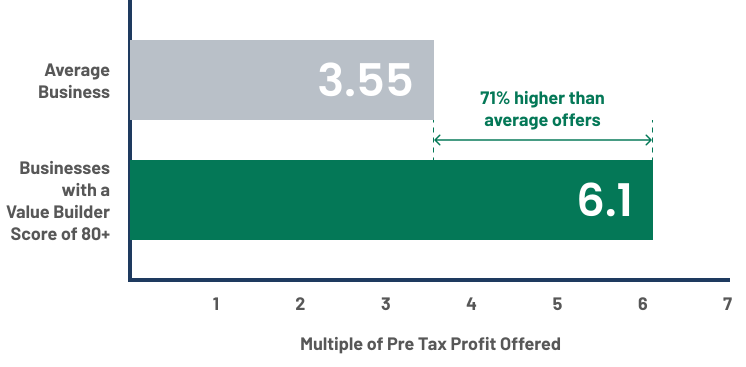
The Value Builder Premium

Lorem Ipsum
Nisl iaculis rhoncus fames adipiscing quis vitae ultrices. Phasellus est at quam suspendisse faucibus quis sem laoreet justo. Volutpat netus ut sollicitudin volutpat.